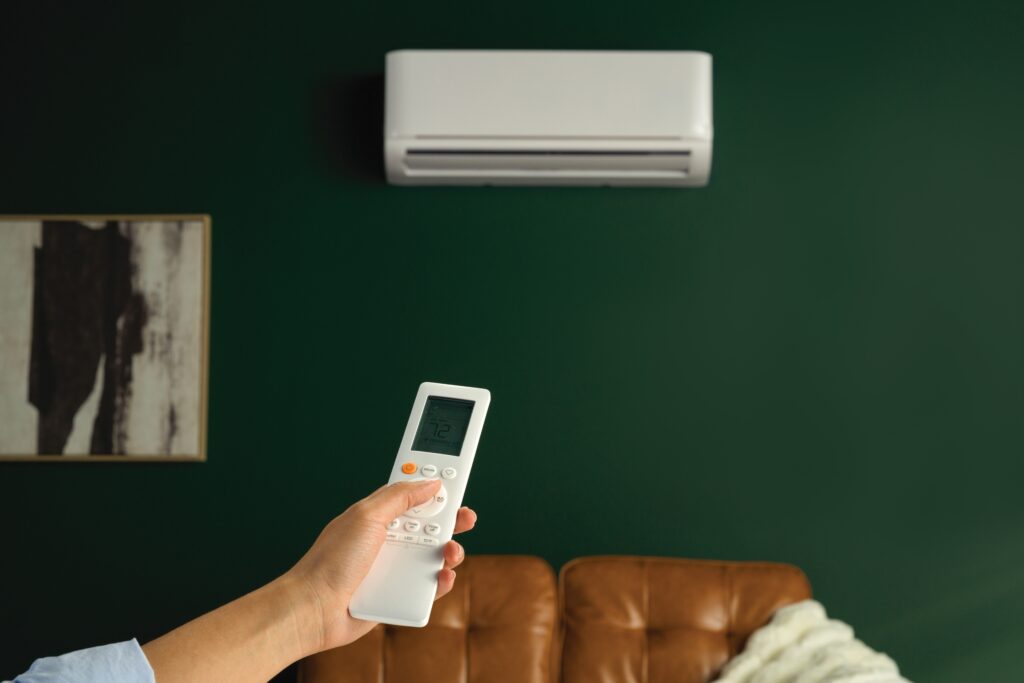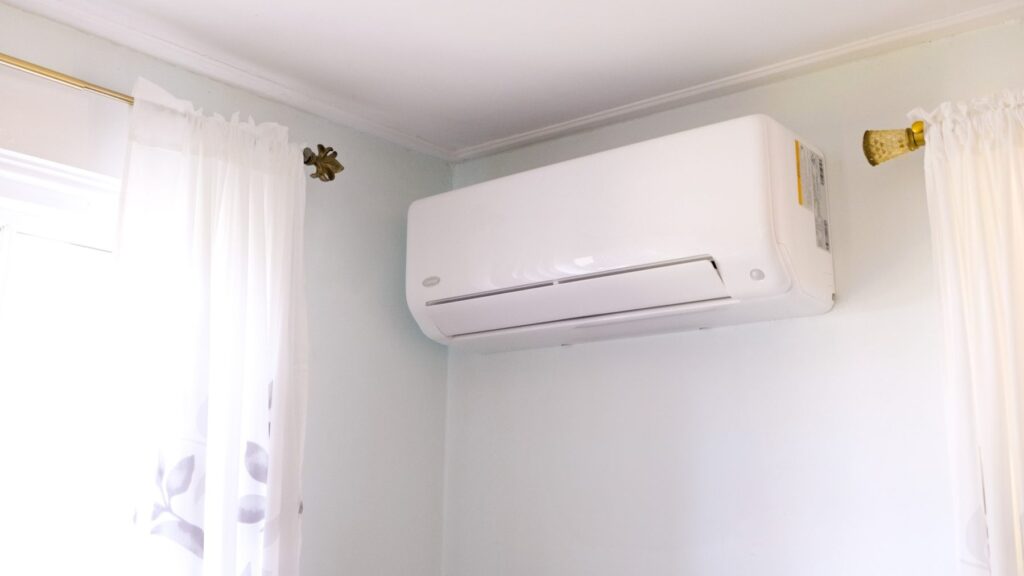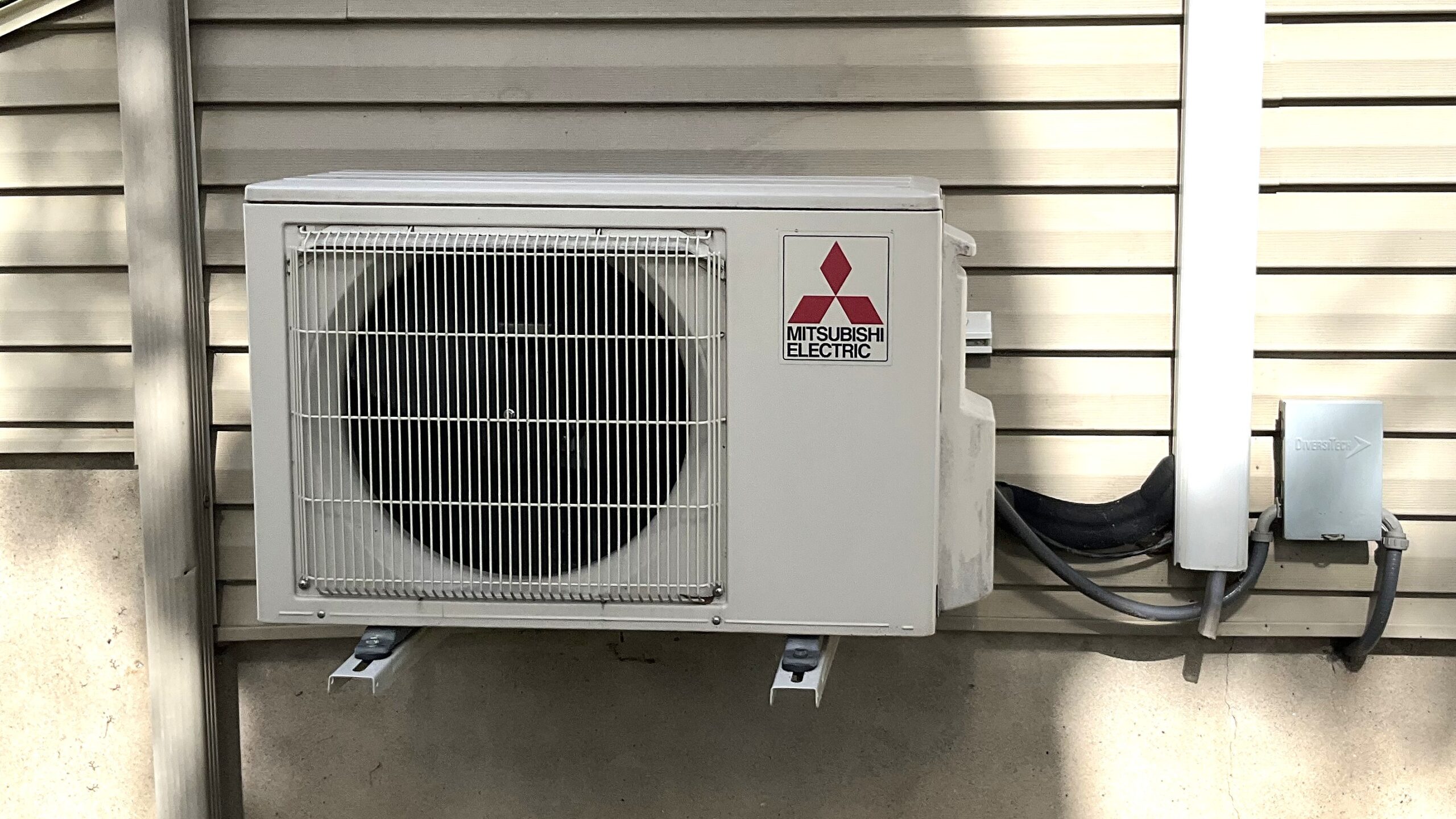
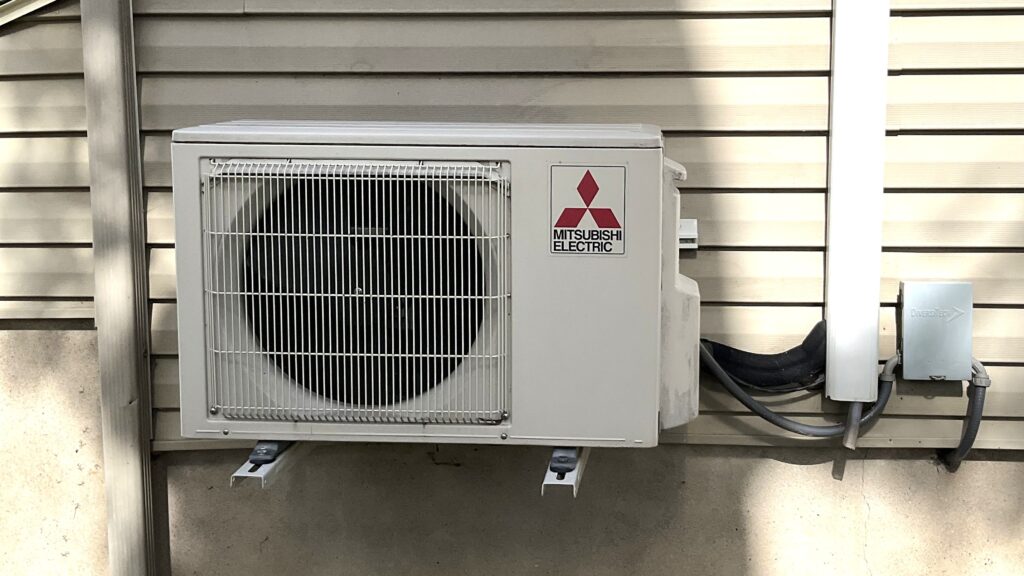
A Mitsubishi mini split system may provide heating and cooling without traditional ductwork. It uses an outdoor heat pump connected to one or more indoor units that serve individual rooms or zones.
This type of system may fit:
- Older homes with boilers or radiators
- Homes without central ducts
- Additions
- Finished basements
- Attic rooms
- Converted garages
- Home offices
- Rooms with different comfort needs
Mitsubishi offers several ductless and ducted heat pump configurations. Some include Hyper-Heating INVERTER technology designed to maintain more heating capacity as outdoor temperatures fall. The exact performance depends on the selected model, equipment match, system size, home, and installation.
How does a Mitsubishi mini split system work?
A Mitsubishi mini split transfers heat between an outdoor unit and one or more indoor units without traditional ducts.
In cooling mode:
- An indoor unit draws in room air.
- Refrigerant absorbs heat from the indoor air.
- The system moves that heat outdoors.
- The indoor unit returns cooler air to the room.
- Moisture removed from the air leaves through a condensate drain.
In heating mode:
- The outdoor unit extracts heat from outdoor air.
- Refrigerant carries that heat indoors.
- The indoor unit releases heat into the room.
- The system adjusts output as the room approaches the set temperature.
What are the benefits of a Mitsubishi ductless system?
A Mitsubishi ductless system may provide heating, cooling, zone control, and flexible installation where ducts are missing or impractical.
Potential benefits include:
Heating and cooling in one system
Many Mitsubishi mini splits are heat pumps, so they can reverse operation to provide both cooling and heating.
Separate comfort zones
A multi-zone design may let different rooms use different settings, subject to equipment design and operating limits.
No traditional duct installation
Mini splits may avoid the space and disruption of adding a full supply-and-return duct network.
Flexible indoor unit choices
Depending on the product family, indoor units may include:
- Wall-mounted
- Floor-mounted
- Ceiling-cassette
- Concealed or short-duct configurations
Variable capacity operation
Mitsubishi’s inverter-driven systems adjust output rather than operating only at full power or completely off. That may support steadier comfort when equipment is sized and installed correctly.
These benefits do not guarantee lower bills or perfect temperatures.
Results depend on:
- Correct sizing
- Zone design
- Insulation
- Air leakage
- Indoor-unit placement
- Outdoor weather
- Electricity rates
- Household settings
- Installation quality
What is Mitsubishi Hyper-Heating?
Mitsubishi Hyper-Heating is a cold-climate heat pump technology designed to retain more heating capacity at low outdoor temperatures.
Mitsubishi publishes several Hyper-Heating configurations, including H2i and H2i plus systems. Current manufacturer materials show that performance varies by model:
- Some H2i models provide full rated heating capacity at 5°F and continue heating below 0°F.
- Certain H2i plus products publish full capacity at temperatures below 5°F.
- Low-temperature operating limits differ across product families.
A homeowner should not assume every Mitsubishi unit has the same cold weather performance.
Universe can help you choose the right heat pump to keep your home comfortable through the coldest winter weather
Are Mitsubishi mini splits suitable for older homes?
Mitsubishi mini splits may be suitable for older homes without usable ductwork, but the building still needs a detailed evaluation. A ductless system may reduce the need to route large ducts through finished walls and ceilings.
The evaluation should still address:
- Electrical panel capacity
- Room-by-room heating and cooling loads
- Insulation and air leakage
- Wall and ceiling construction
- Line-set routing
- Condensate drainage
- Outdoor unit location
- Snow and ice exposure
- Number of indoor zones
- Historic or architectural concerns
The “best ductless mini split for an older home” is not one universal model. It is a properly selected equipment combination that matches the home and intended use.
How does a Mitsubishi mini split compare with central air?
A Mitsubishi mini split serves rooms through individual indoor units, while central air usually distributes conditioned air through ducts.
| Consideration | Mitsubishi Mini split | Central Air |
| Traditional ducts | Not required for ductless units | Usually required |
| Room control | Common by zone | Depends on zoning design |
| Indoor appearance | Indoor units are visible | Registers are less prominent |
| Retrofit use | Often practical without ducts | May require new ductwork |
| Heating | Many systems are heat pumps | May pair with a furnace or heat pump |
| Whole-home design | Requires planned indoor zones | Uses a central distribution system |
| Maintenance | Each indoor unit needs care | Central equipment, filters and ducts need care |
A Mitsubishi system may fit when:
- No usable ducts exist
- Rooms need separate control
- An addition is difficult to connect
- The home uses boiler or baseboard heat
- Heating and cooling are being considered together
Central air may fit when:
- Good ducts already exist
- Most rooms follow similar schedules
- Concealed distribution is preferred
- A central system can serve the home effectively
What does Mitsubishi mini split installation involve?
Mitsubishi mini split installation involves system design, equipment matching, electrical work, refrigerant piping, drainage, startup, and testing.
A typical project may include:
- Calculating room-by-room loads
- Deciding whether the system is primary or supplemental heat
- Selecting indoor-unit styles
- Matching indoor and outdoor equipment
- Planning outdoor-unit placement
- Reviewing electrical capacity
- Routing refrigerant lines
- Planning condensate drainage
- Confirming permits and inspections
- Mounting the equipment
- Pressure testing and commissioning
- Testing controls, drainage, temperatures, and operation
- Registering eligible equipment and explaining warranty requirements
Mitsubishi mini split installation is not simply mounting an indoor head. Equipment compatibility, refrigerant work, electrical service, drainage, and commissioning affect performance.
What affects Mitsubishi mini split installation cost in New York?
Mitsubishi mini split installation cost depends on the equipment, number of zones, heating requirements, electrical work, routing, drainage, access, and project scope.
Cost drivers may include:
- Single-zone or multi-zone system
- Indoor-unit quantity and style
- Outdoor-unit capacity
- Hyper-Heating equipment
- Efficiency and cold-climate ratings
- Electrical-panel upgrades
- New circuits or disconnects
- Refrigerant-line length
- Line-cover or concealment work
- Condensate pumps
- Ground, wall, or raised mounting
- Snow-clearance planning
- Equipment access
- Permit and inspection requirements
- Removal of old equipment
- Finish repairs after installation
A written proposal should identify:
- Model numbers
- Number of zones
- Heating capacity at low temperatures
- Electrical scope
- Refrigerant-line routing
- Drainage
- Mounting
- Controls
- Permits
- Testing
- Warranty
- Exclusions
Are Mitsubishi systems ENERGY STAR certified?
Some Mitsubishi mini split and heat pump models are ENERGY STAR certified, but certification must be checked for the exact equipment combination. ENERGY STAR provides searchable product listings for certified heat pumps.
Contractors and homeowners should verify:
- Outdoor model
- Indoor model or approved combination
- Heating and cooling ratings
- Cold climate designation, when relevant
- Certification status at the time of purchase
Do not assume that every Mitsubishi product or every equipment combination has the same certification.
What is the practical next step?
The practical next step is to have the home evaluated for room loads, equipment placement, electrical capacity, drainage, and cold weather heating needs.
Before scheduling, list:
- Rooms needing heating or cooling
- Existing heating equipment
- Areas that remain uncomfortable
- Desired temperature zones
- Electrical panel information
- Preferred indoor unit locations
- Outdoor unit options
- Renovation plans
- Budget and financing needs
Schedule service with Universe to find out if a Mitsubishi mini split system is right for your home
Frequently Asked Questions
What is a Mitsubishi mini split system?
A Mitsubishi mini split system is a heat pump or air conditioning system that connects outdoor equipment to one or more indoor units without traditional ducts. Many models provide both heating and cooling.
What is Mitsubishi Hyper-Heating?
Mitsubishi Hyper-Heating is cold climate heat pump technology designed to retain more heating capacity as outdoor temperatures fall. Capacity and minimum operating temperatures differ by model, so homeowners should review the exact performance data.
Can a Mitsubishi mini split heat a whole house?
A Mitsubishi mini split may heat a whole house when the equipment and zones are designed to meet the calculated heating load. Closed rooms, multiple floors, insulation, air leakage, outdoor temperature, and backup heat needs affect the design.
How does a Mitsubishi mini split compare with central air?
A Mitsubishi mini split uses individual indoor units, while central air usually distributes conditioned air through ducts. The better fit depends on existing ducts, zoning needs, indoor appearance, installation scope, and heating goals.
Are all Mitsubishi mini splits ENERGY STAR certified?
Not every Mitsubishi mini split or equipment combination should be assumed to have ENERGY STAR certification. Homeowners should verify the exact indoor and outdoor model combination through the current ENERGY STAR Product Finder.
Can homeowners install a Mitsubishi mini split themselves?
Mitsubishi mini split installation generally involves professional electrical work, refrigerant handling, drainage, equipment matching, startup, and code compliance. Homeowners should not open electrical or refrigerant components.